

It started with a test
Most comic book fans will know about Deadpool’s long road to the silver screen. Hired as director, Miller pitched his version of the film to Fox and ultimately produced an all-CG test starring a mo-capped Ryan Reynolds in a frenetic freeway fight scene. Fox did not move ahead with the film but a few years later that test leaked, and the Internet fandom loved it, ultimately greenlighting Deadpool. Miller, who has owned and run Blur Studio for the past 20 years, had accumulated a wealth of storytelling experience in the animation and CG realm, which he now had to transplant to a live action film.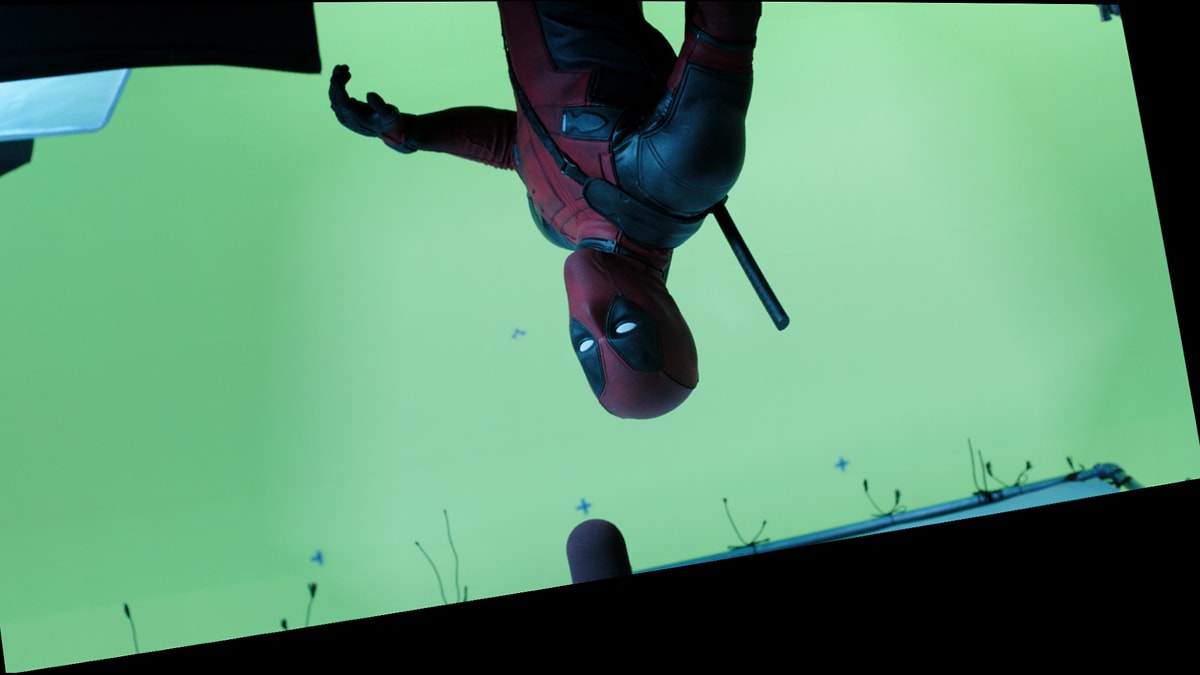
To help him through the film’s visual effects challenges, Miller enlisted Rothbart to help pull off what would be around 1200 extremely challenging shots - both technically difficult but also required to fit into Miller's 'R-rating' approach to the comic book story. “We kept on saying we really should have put up a quote board on this show, because I’ve had the most insane conversations with my crew about how much blood and gore and other weird stuff there should,” says Rothbart. “And even the dialogue for Deadpool informed the VFX, so for example I’d be having this conversation with Weta Digital, who did some facial animation, saying, ‘No no no, his eyebrows need to go up on ‘shit’, and down on ‘fuck’.’”
Designing a title sequence for laughs is harder than you think
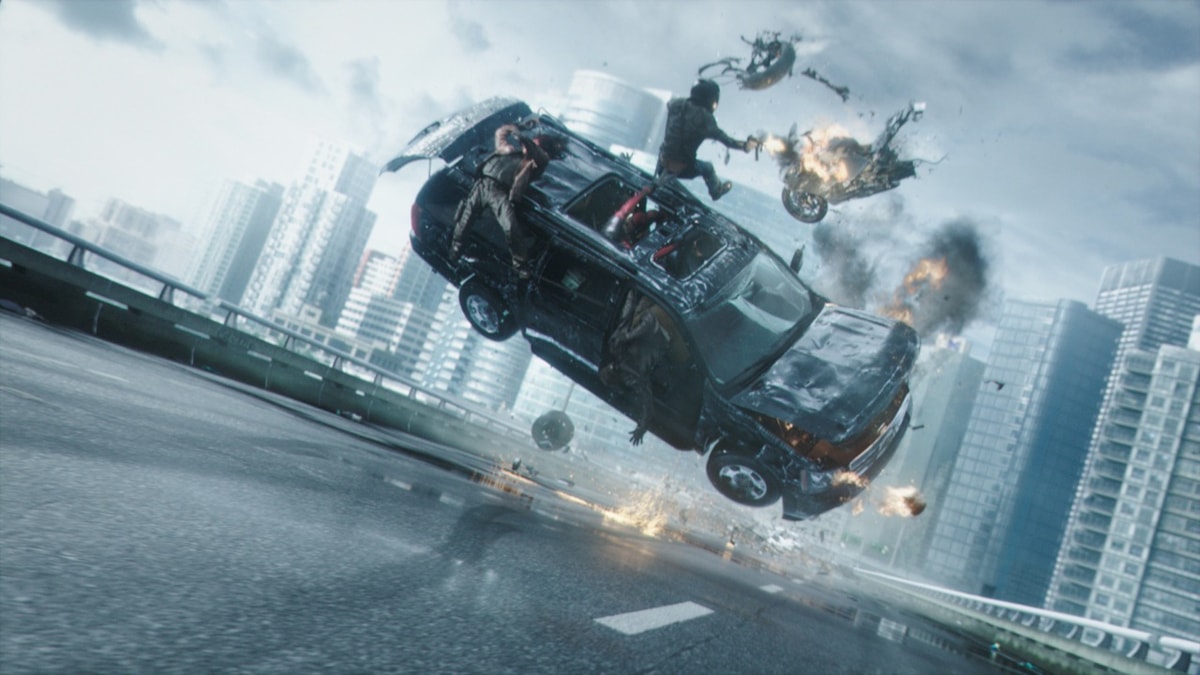
Deadpool’s opening titles - a 85 second full CG frozen moment mid-freeway crash that’s populated with such titles as ‘Directed by an overpaid tool’ and ‘Produced by asshats’ - has already garnered incredible attention and praise for establishing the irreverent tone of the film. But just formulating and pulling off a sequence that establishes the right feel and introduces Deadpool was not easy. In fact, it took careful planning from Blur Studio, under visual effects supervisor Pauline Duvall, to bring to the screen.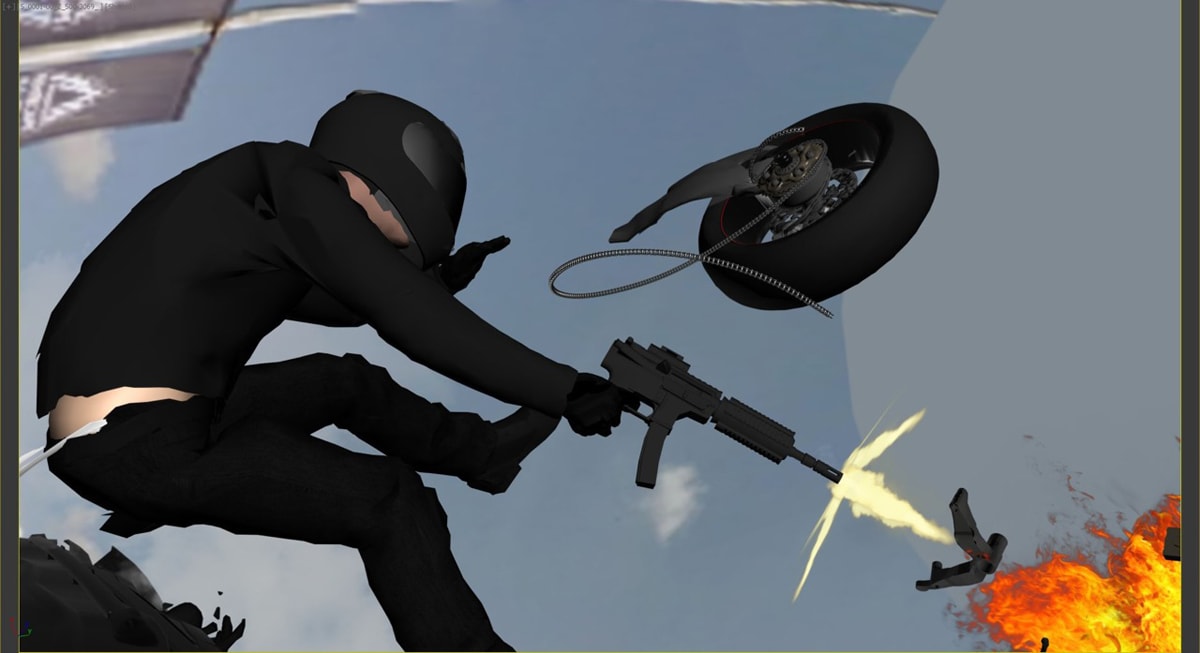

To make the all-CG shots, Blur initially previs’d the action. Then, since the frozen moment was intended to hook up with a later view of the crash that would be orchestrated by Atomic Fiction, Blur received assets from Atomic and then adapted them for the studio’s 3ds Max and V-Ray pipeline. “We had to up-res a lot of things,” notes Balson. “The title sequence is macro photography for half of it, where you get really close to small parts of the car.”

How to make a freeway chase when you don’t have a freeway
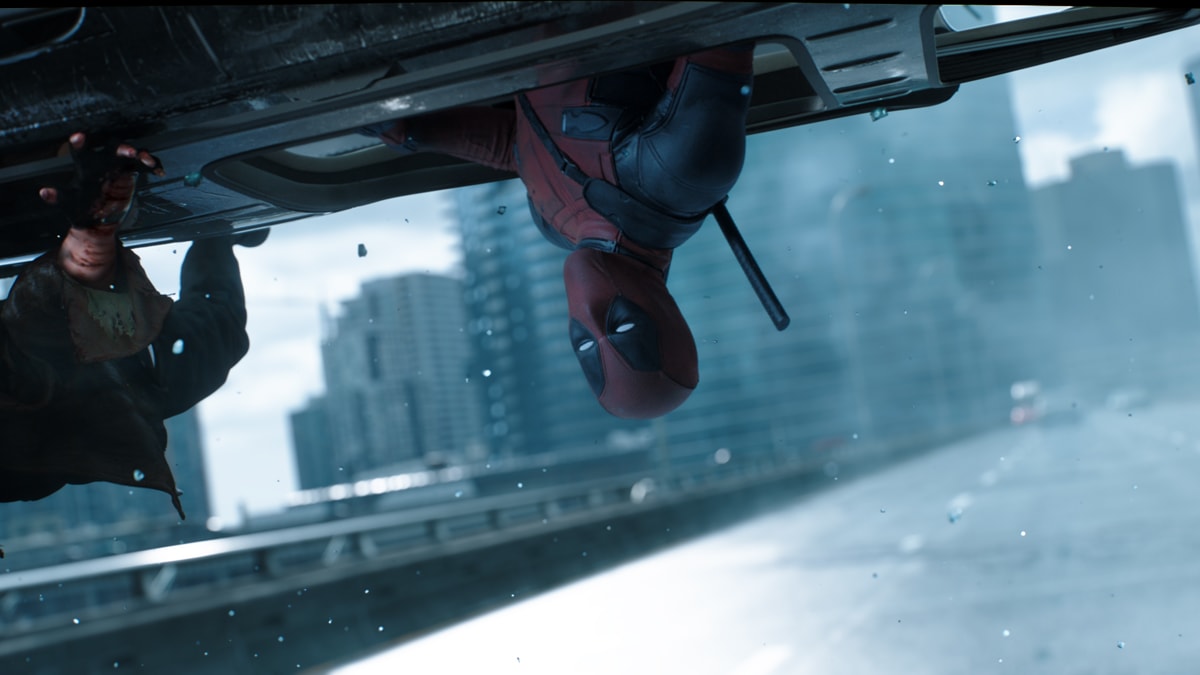
One of Deadpool’s signature sequences is a freeway battle as the titular character takes on a group of evil mutant Ajax’s thugs in their moving vehicles. Audiences had had a glimpse of the scene in the leaked CG test footage that Miller and Blur had produced some years earlier, but of course now it was revisited for the feature film. Except there was one problem - it was difficult to find a freeway that could be used for choreographing the complicated set of stunts. The solution was to have vehicle interiors and other action filmed on greenscreen, making use of multi-cam freeway plates shot in Detroit and projected with LED lightboxes, and then for the vehicles, the freeway and environments to be constructed digitally.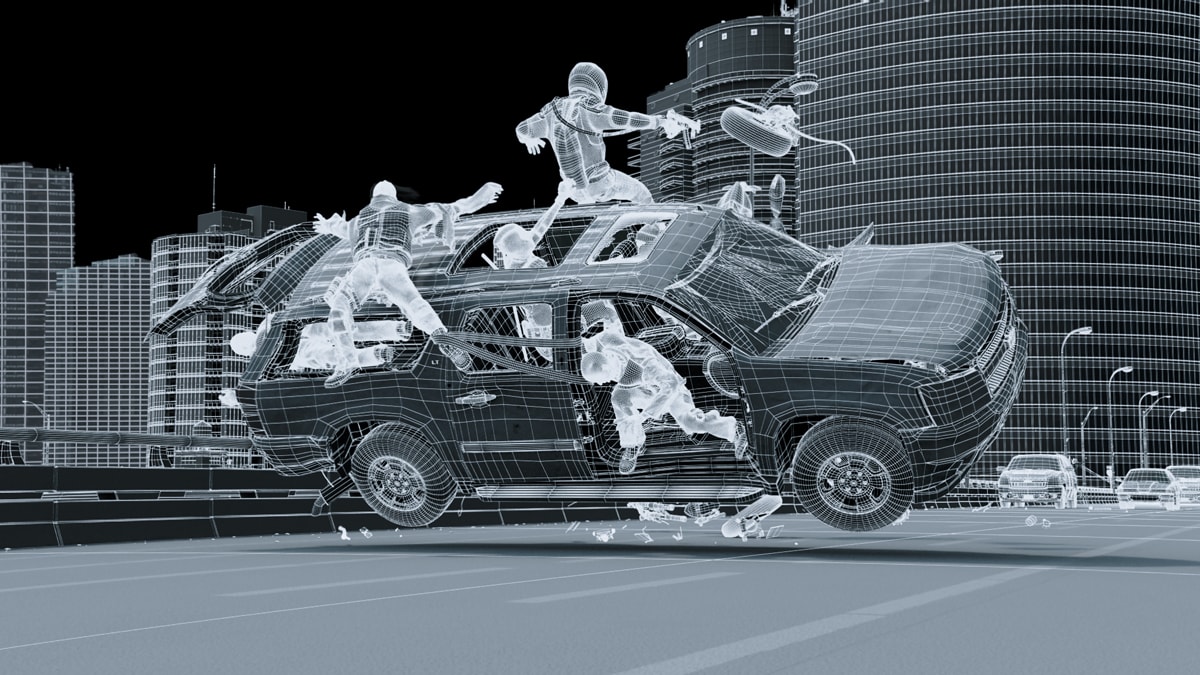
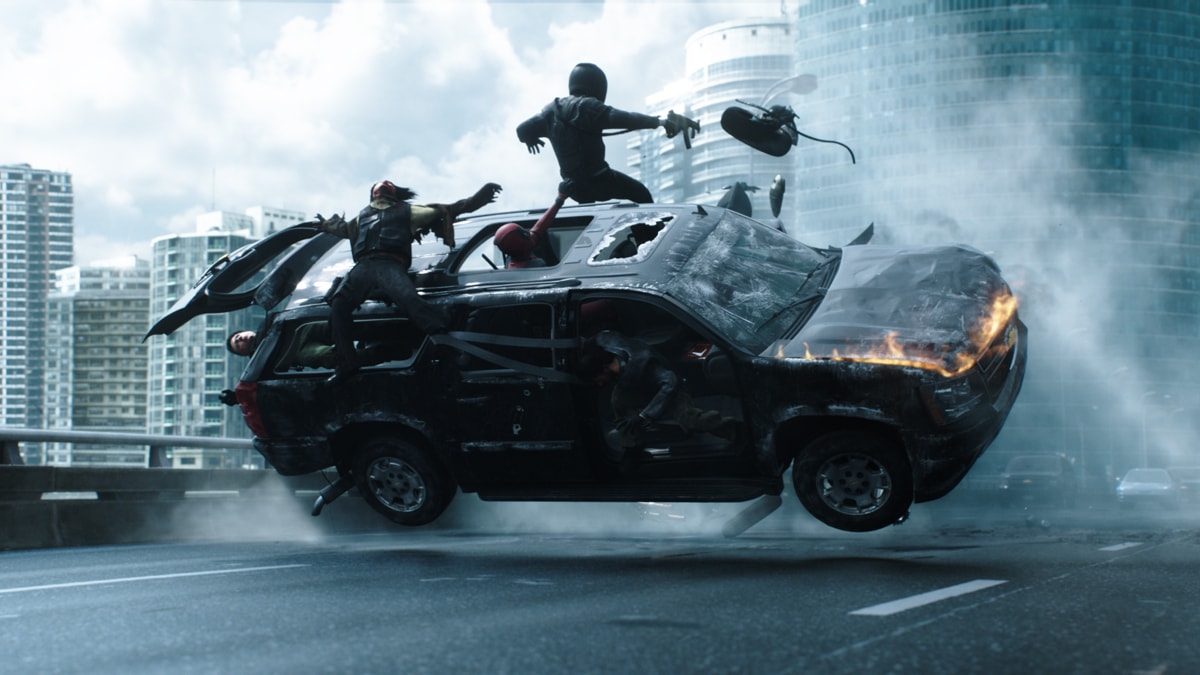
The greenscreen shoot also involved several stunts, such as one part of the sequence where a thug hangs off the back of a vehicle. “We actually had him on a treadmill and scraping along the ground of a treadmill as he went along,” says Rothbart. Other stunts that could not be performed safely were captured on a motion capture stage to facilitate action for CG thugs and a CG Deadpool. “Even the guys on the motorcycles,” notes Rothbart, “we would capture on a rig that would be like a motorcycle to get their motion and movement.”
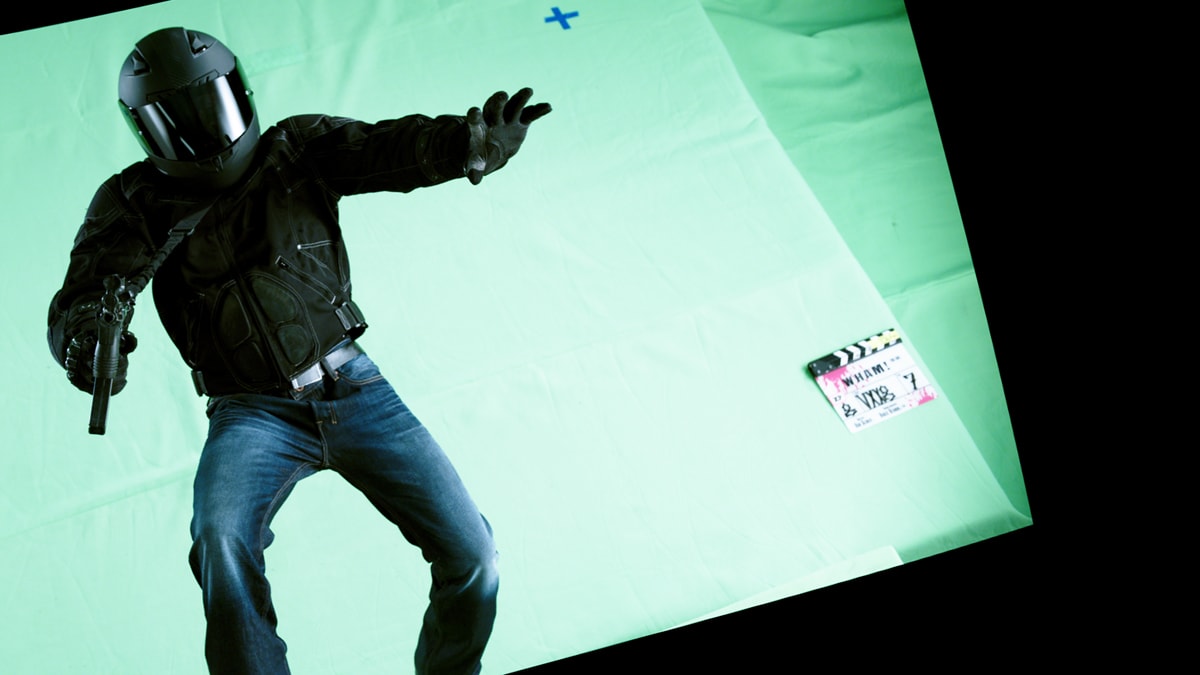
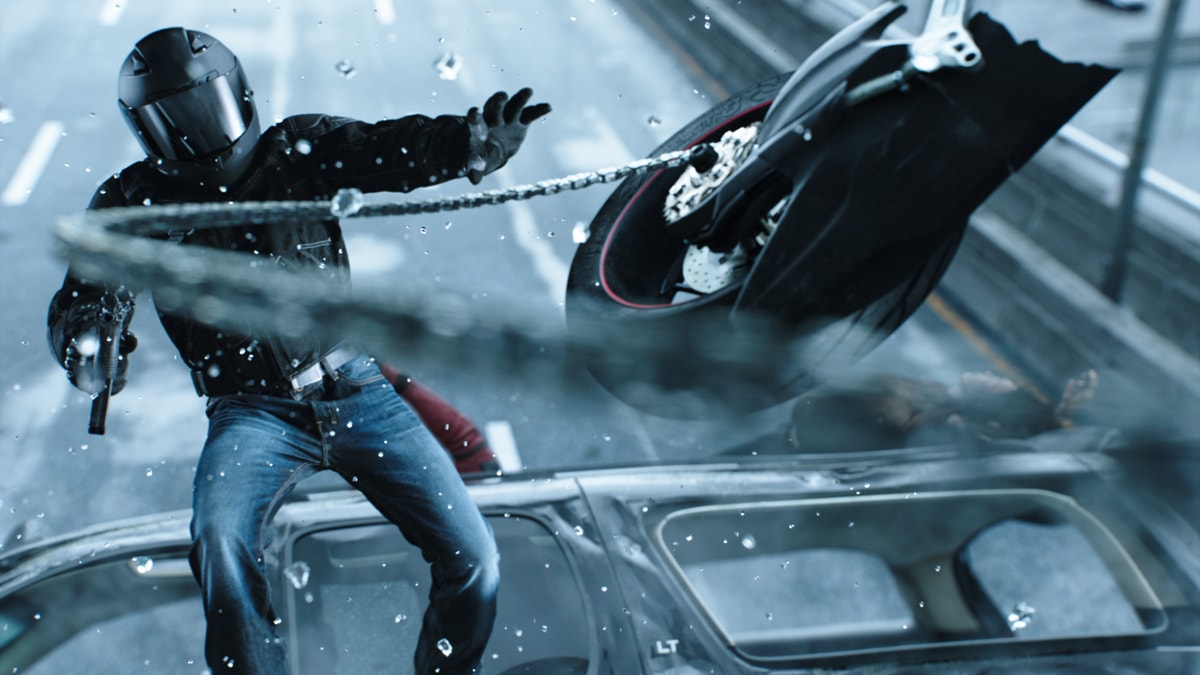
“We would also vary the look of things a bit,” adds Tudhope, “because the one thing we didn’t want to do was have the audience see the same looking stuff for four minutes. So everything from the design of the city, which was a more run-down industrial area, then as we moved through it was an older 1930s-50s architecture and we come out to a more modern side of town which was the Vancouver glass skylines. Even the wet down on the road, we would change our road shader from section to section a bit so it felt like certain areas were wetter than other areas.”
The many faces of Colossus
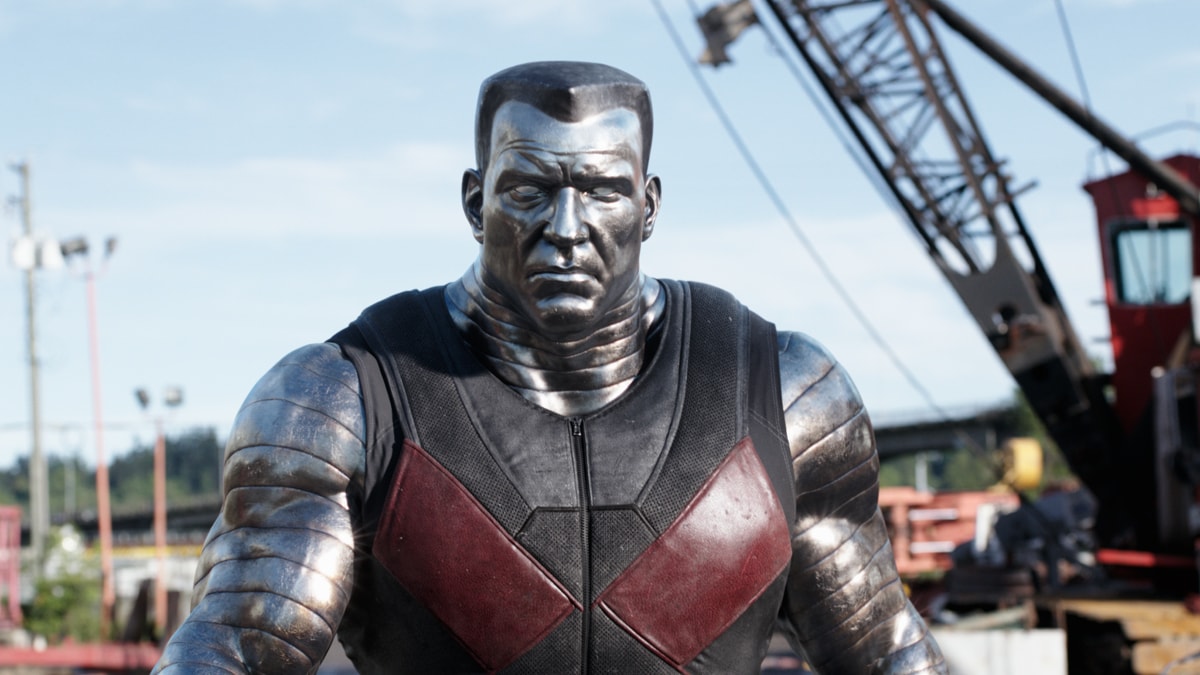
We’ve seen Colossus before in the X-Men universe, but Deadpool’s Colossus is something different, something very different. In fact, Colossus is a mish-mash of more than five different performances from actors and stunties acquired on-set, in motion capture and via facial animation techniques - all designed to represent an older and more battled-scared Russian metallic mutant that was faithful to the comic books. But to get there involved a significant combination of live action performance then digital work by Digital Domain, which utilized its MOVA and Direct Drive tech. Blur Studio also contributed several key Colossus shots.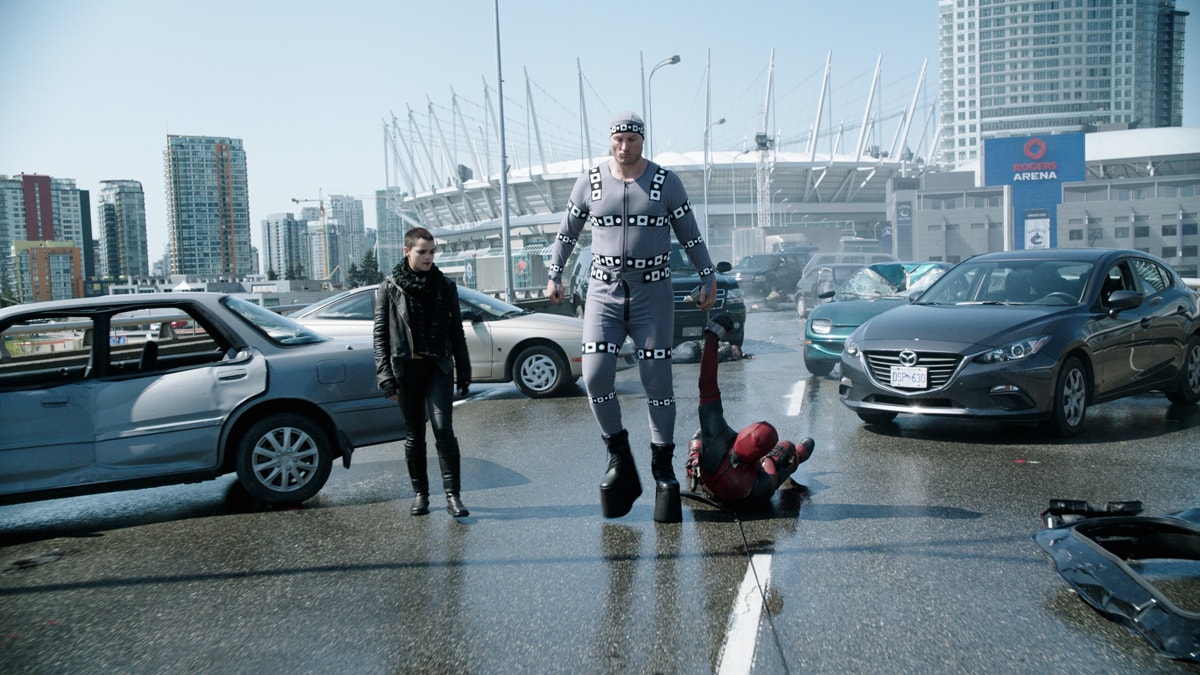

Actor T.J. Storm carried out Colossus motion capture for body motion. Yet another actor, Glenn Ennis, a stunt performer on the film, was the inspiration for the chiseled jaw look behind the character and underwent a FACS session to acquire the right face shapes. Actor Stefan Kapičić was the final voice of Colossus.
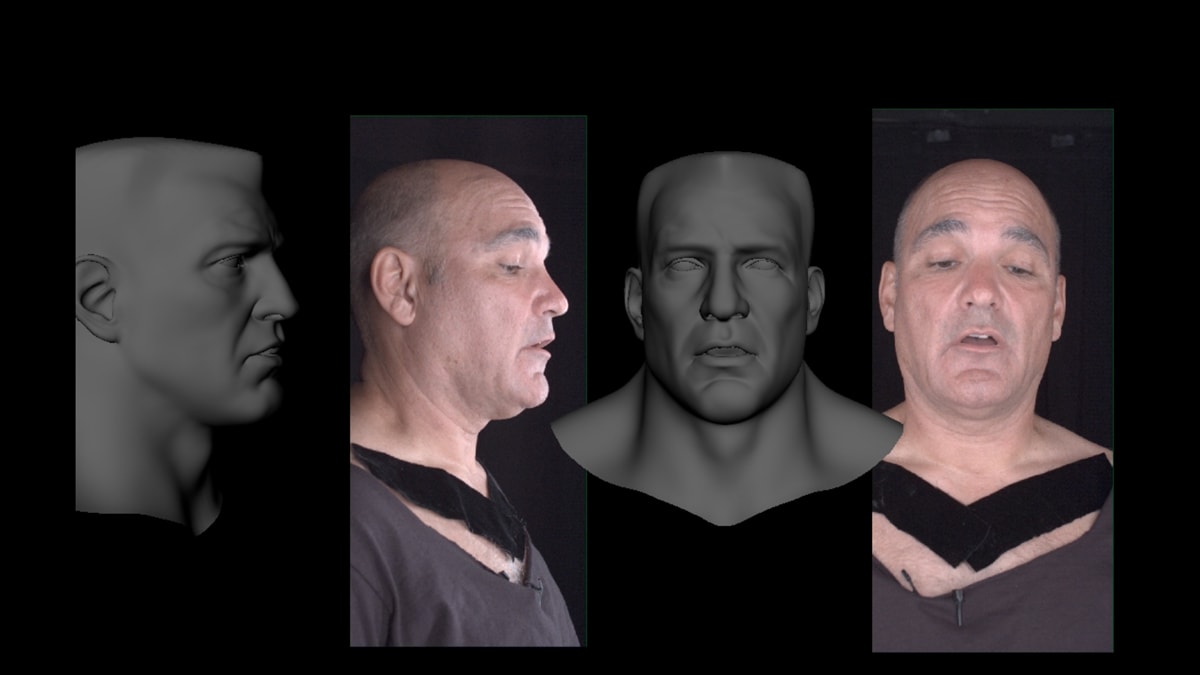
Since MOVA provides a 1:1 way of capturing facial performance, Digital Domain had to re-target Greg’s performance (remember, Greg doesn’t look like Colossus) to the CG model of the character. To do that Digital Domain used its Direct Drive system. This involved taking the MOVA motion and re-targeting that to the CG Colossus. “The Direct Drive system we developed,” explains Digital Domain animation director Jan Philip Cramer, “is all about taking the motion and re-targeting that onto any character you like but maintaining all the details and high friction, the subtle wrinkle details that you capture with MOVA but transferred onto a completely different looking character.”
“We also do a regular face solve like with traditional facial mocap and we put that onto a FACS rig,” adds Cramer, “so the animators still control what we did but we maintain all the beautiful detail of the skin sliding and the additional high frequency information that you simply don’t get when you marker up the face and run around with the head cam.”
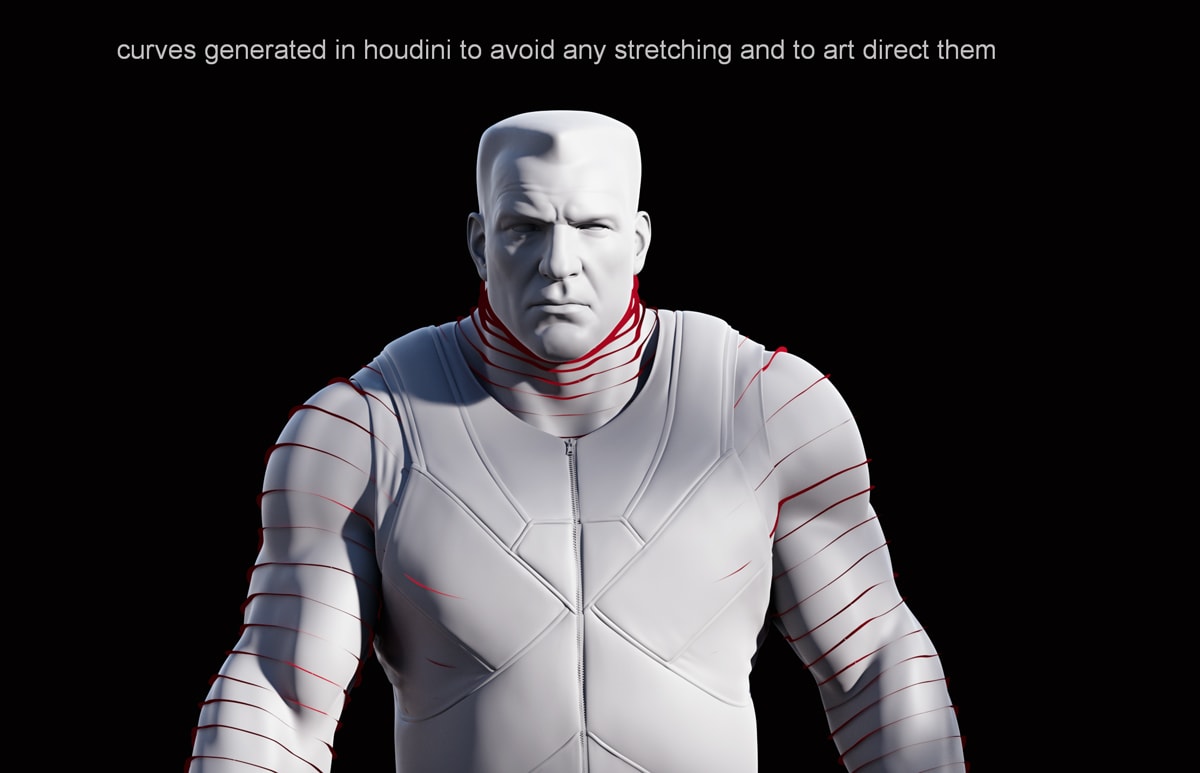
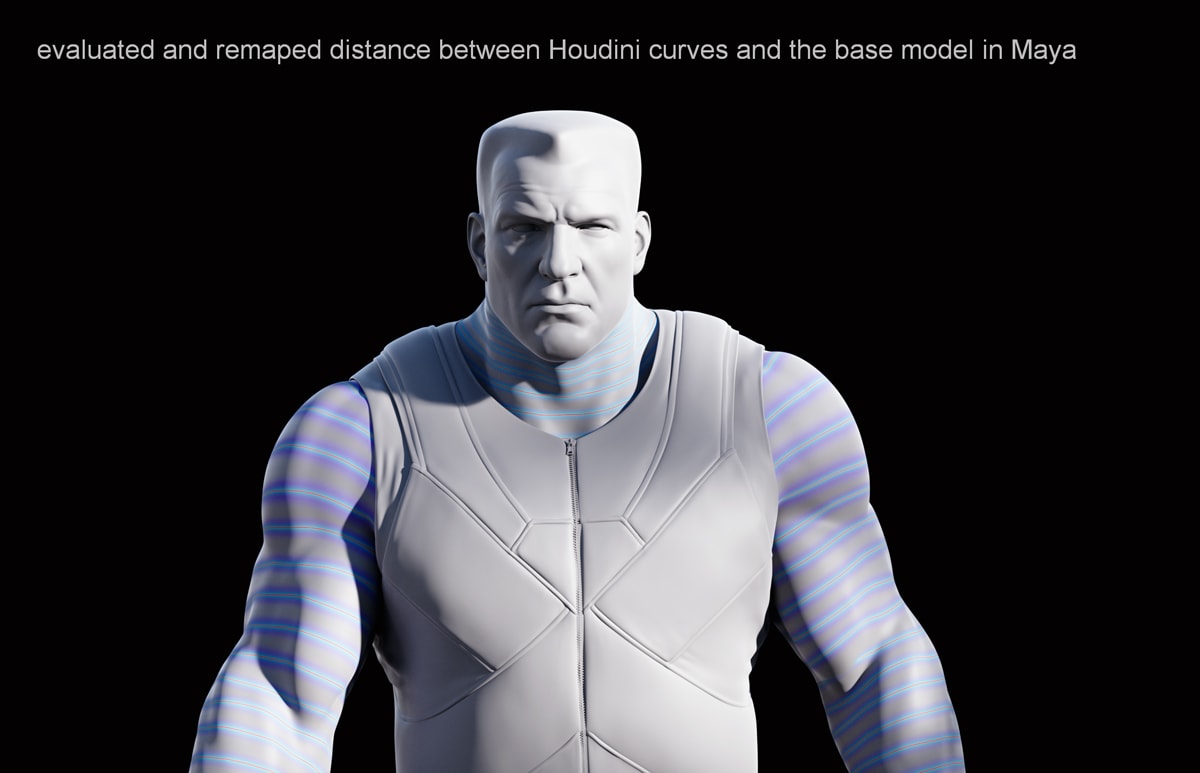
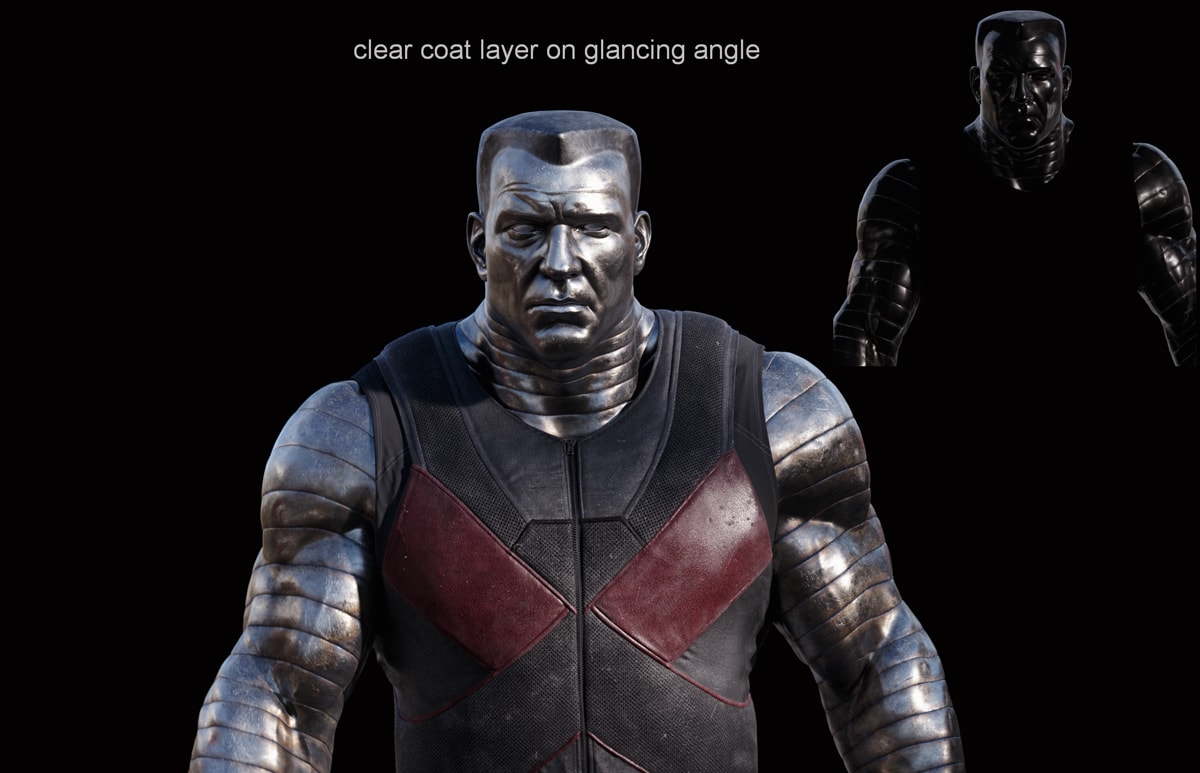
If the facial performance weren’t complex enough, Colossus’ metallic finish provided a whole new set of technical challenges. The first was to make his chrome finish not look too ‘chromey’, and for that Rothbart sought out specific reference. “We even went so far as going to a metal company and had them give us a whole bunch of different samples of different types of steels,” the VFX supervisor says. “For Colossus' main body, we ended up with cold rolled steel as the metal look. His hair, which is a much darker look, we used hot rolled steel. It was important to have a patina, and mostly around his ridges you’d get this rainbow-y coloration, when metal gets overheated or when you get oil on it over time. We worked that into it as well, just to make it look different.”
Digital Deadpool
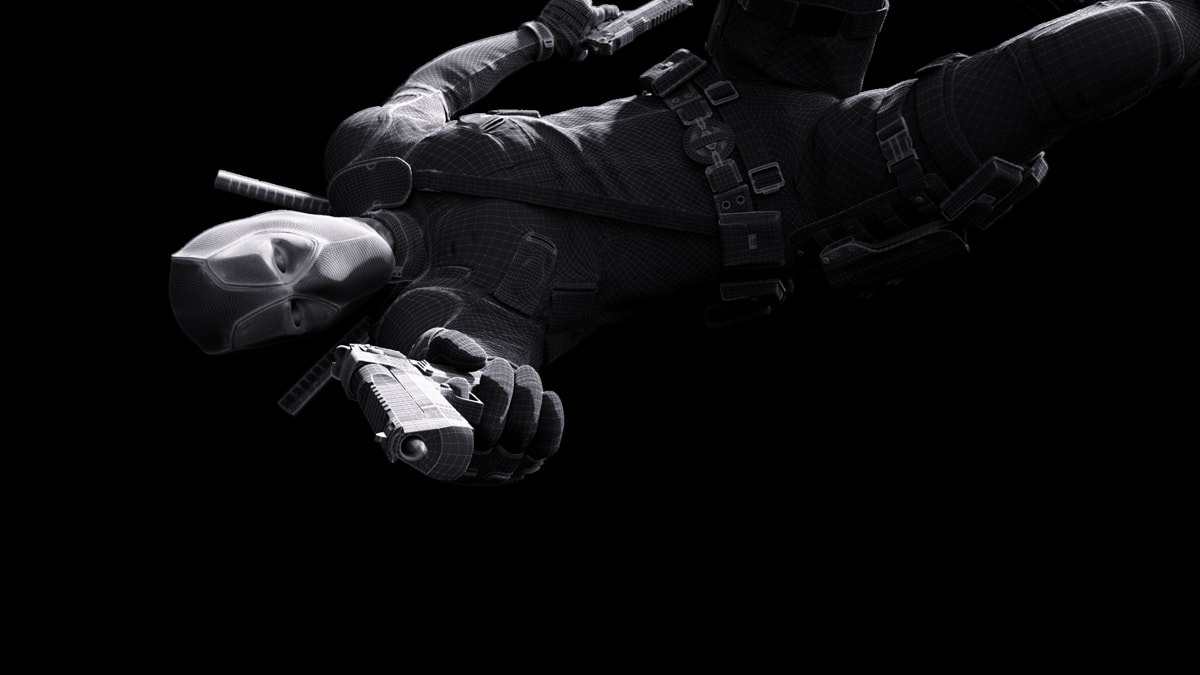
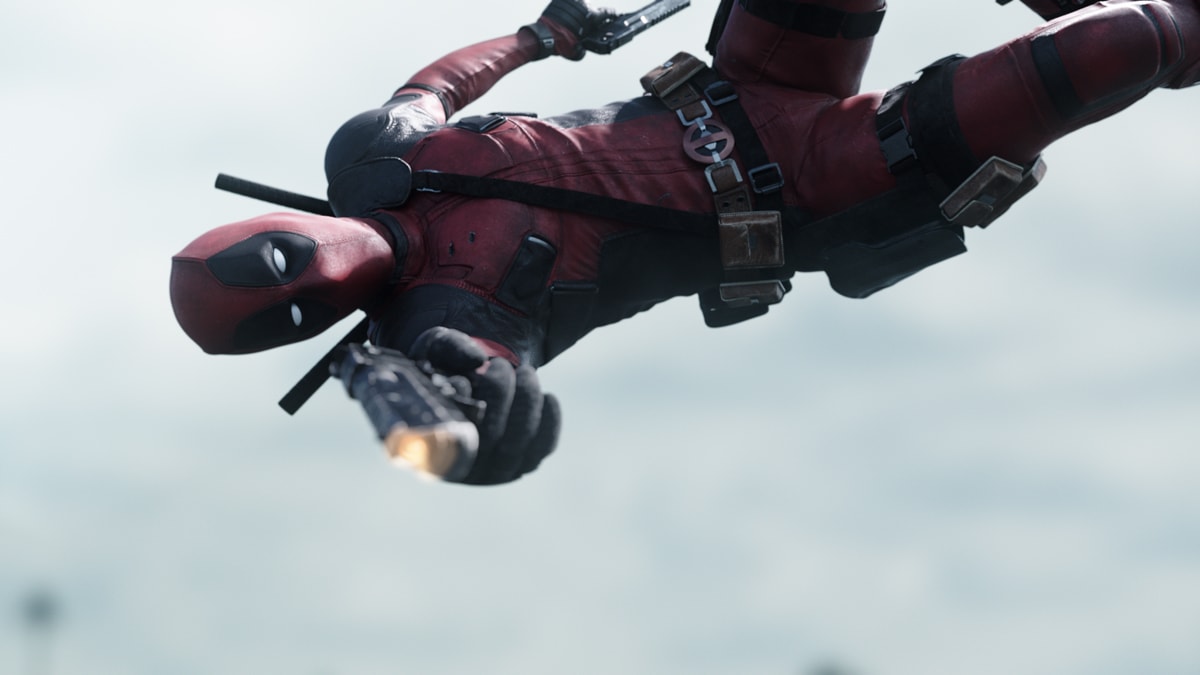
As much as possible, Deadpool himself was brought to life with stunts overseen by supervising stunt coordinator Robert Alonzo and stunt coordinator Philip Silvera. But where the character’s actions were more extreme, various VFX facilities relied on a shared model and textures built by Digital Domain. “Going through the CG process was almost the same thing they went through for the costume design of Deadpool,” notes Rothbart.
“The costume is made of this mesh so all the dirt would get into the gutters and the cracks and crevices of the costume. Then all the ridges of the mesh would stay nice and clean, so anytime sun would be on it and the light hits it, it still takes that orangey hue but as soon as it goes in the shadow it dropped to this more blueish of the dirt. So dialing in that balance to our CG costume was a bit of work.”
Those textures, almost like heat marks around the lines were rendered procedurally in V-Ray after artists had hand-painted vector maps to give the correct flow of the anisotropic reflections. Further work was also required to integrate Colossus into what were massively shifting outdoor environments owing to varying weather conditions. “When we knew he wasn’t going to look good,” says Digital Domain visual effects supervisor Alex Wang, “we made sure to integrate Colossus so that he looked good first and then we would replace the sky and alter the plate as much as we could by say adding more sunlight or spec highlights in the plate.”As much as possible, Deadpool himself was brought to life with stunts overseen by supervising stunt coordinator Robert Alonzo and stunt coordinator Philip Silvera. But where the character’s actions were more extreme, various VFX facilities relied on a shared model and textures built by Digital Domain. “Going through the CG process was almost the same thing they went through for the costume design of Deadpool,” notes Rothbart.
“The costume is made of this mesh so all the dirt would get into the gutters and the cracks and crevices of the costume. Then all the ridges of the mesh would stay nice and clean, so anytime sun would be on it and the light hits it, it still takes that orangey hue but as soon as it goes in the shadow it dropped to this more blueish of the dirt. So dialing in that balance to our CG costume was a bit of work.”
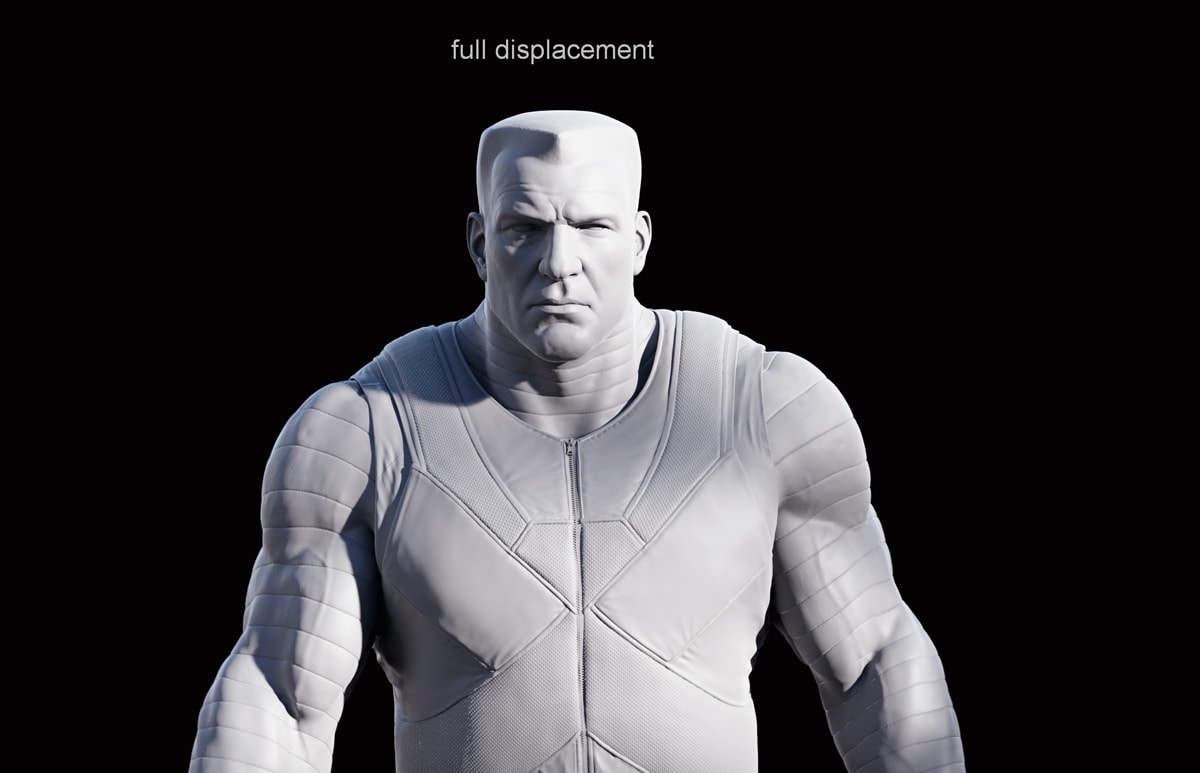
Blur would also take on several Colossus scenes using DD’s asset, including an awkward taxi ride and ‘damaged’ Colossus shots after the final battle. “DD delivered a model and textures to us and we we would match what they had,” outlines Blur visual effects supervisor Pauline Duvall. “We referenced all sorts of damaged metal and the way it tarnishes. We also had to deal with Colossus’ facial animation and also his ridges and the way they ride along the curvature of his body - the way that those ridges glided along his muscles, the textures had to take on some more movement.”
“That cab ride scene,” identifies Rothbart, “is just so funny. Tim wanted to do things to mess with Colossus, who’s almost like the comic relief in the film. We have this 7 foot 8 guy stuck in the back of the cab for the ride - he’s hunched over. Then we had him drink a cup of coffee and we had to give him a straw to sip because he’s so scrunched in there. Then we had him put his pinky out so he’s drinking it like a dainty girl. Blur is so great with character. It’s just a funny scene in the movie.”
Emoting, the Deadpool way
Ryan Reynolds performs much of Deadpool behind a full face mask - it formed a solid shell from the upper lip up and resulted in what Rothbart describes as ‘chinwag’. “We got so much emotion from Ryan,” he says, “but we realized that we needed more expression and animation in the eyes and face. The immediately posed the problem of a blow-out in visual effects shots and the possibility that every Deadpool scene might require tracking markers on Reynolds and a 3D head replacement with lip sync (since a simple spline warp did not yield desirable results). Instead, however, a much more ingenious 2D-ish solution was devised by Weta Digital and used for about 250 facial animation shots.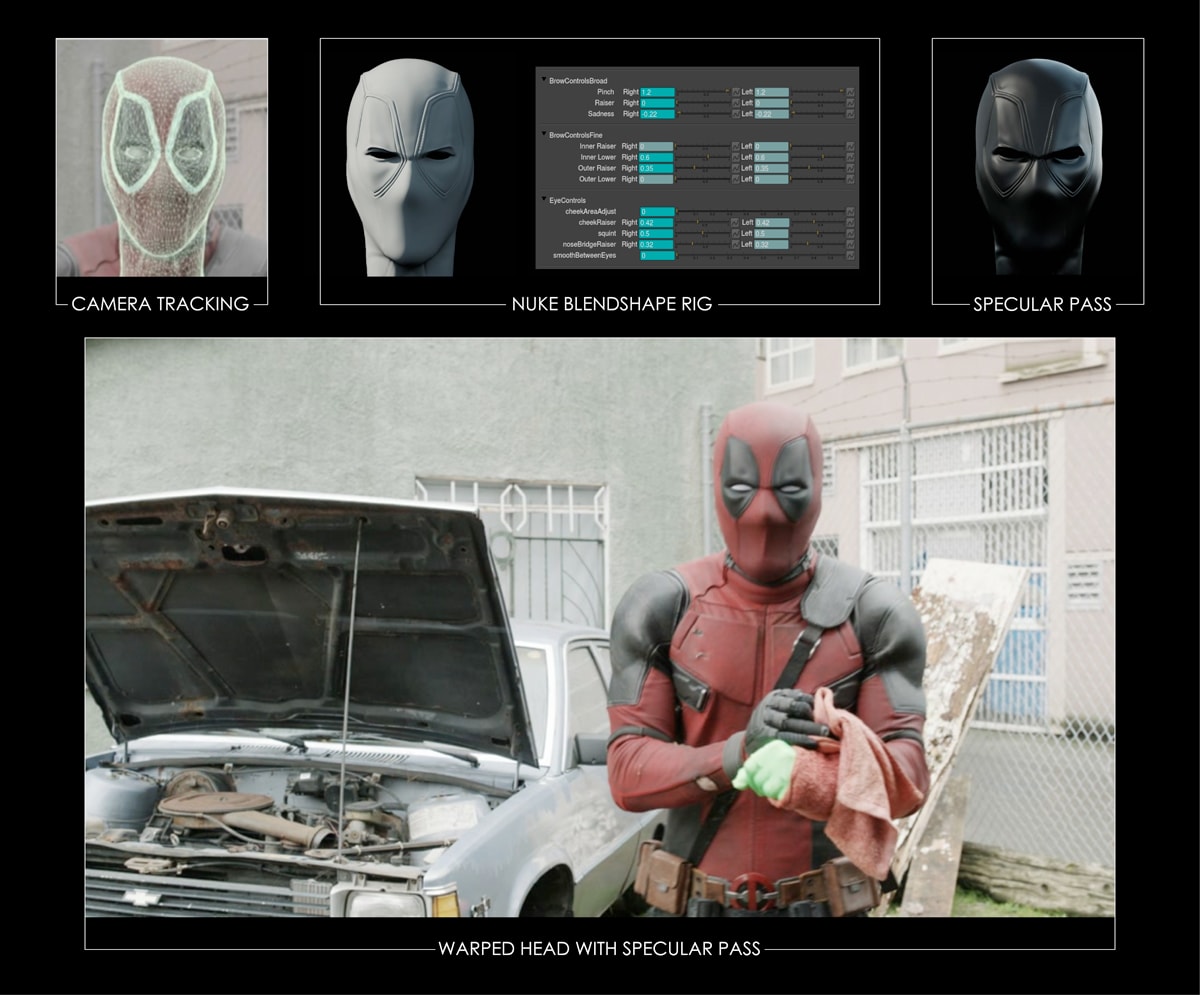
So, how did the system actually work? It began with Weta Digital receiving a package of materials, including Deadpool digi-double assets. Some of them had mask expressions built in. “We exported all of these OBJs as OBJs separately from the Maya files into NUKE and we oriented the head facing a 50mm camera framed similarly to the way Ryan Reynolds was framed in the reference clips,” says Weta Digital visual effects supervisor Charlie Tait. “We called this ‘Headspace’ - that was useful to us because it meant we could animate in the same sort of context. That means we could have the Deadpool head next to the Ryan Reynolds head.”
Using this so-called Headspace camera, artists could project a UV ramp on each of the different Deadpool models and wrap it to make it like a texture. “Then we took a neutral pose of the head with no expressions on it,” continues Tait, “and we subtracted that in texture space from the other. So we effectively had the difference between the neutral pose and any given expression. Then we would put a multiplier on all those different expressions, add them all up, add them to the neutral pose and that is now our UV ramp.”
As well as completing a range of VFX on the film, Image Engine was also tasked with several Deadpool facial animation shots. Interestingly, these were used in promotional materials such as IMAX trailers and an Empire Magazine piece. Using dialogue video recordings of Reynolds, Image Engine undertook a mostly 2D process but with 3D assets, as visual effects supervisor Robin Hackl explains:
“We would accurately match move the head of Deadpool. Then once we had the match move and reference for the animator to take over, we did a 3D animated version of our Deadpool head. For our 2D approach, we wouldn’t actually do a final 3D render. But once we had the 3D animated head, we move that asset into the effects department - we had a process where we rendered the difference between the static non-animated matchmove head and the animated head. That would give us a ‘distort vector pass’ - a Houdini rendered layer - we would then be able to take that layer, apply that in NUKE in comp and thus deform the original master plate, pushing the pixels around to effectively match the 3D animated head.”
That UV ramp was then used in the correct camera space to perform a warp on the plate. “Ultimately,” notes Tait, “all we actually do in the end is perform a single STMap warp using that projected UV map, with all of those sort of differences of possible expressions built into it. The way that was all controlled - how much of each expression we’re using - was a node made in NUKE with a bunch of sliders that referenced what was actually going on. You’d have eyebrow raises, a pinch and cheek raises, all sorts of possible facial expressions.”“We would accurately match move the head of Deadpool. Then once we had the match move and reference for the animator to take over, we did a 3D animated version of our Deadpool head. For our 2D approach, we wouldn’t actually do a final 3D render. But once we had the 3D animated head, we move that asset into the effects department - we had a process where we rendered the difference between the static non-animated matchmove head and the animated head. That would give us a ‘distort vector pass’ - a Houdini rendered layer - we would then be able to take that layer, apply that in NUKE in comp and thus deform the original master plate, pushing the pixels around to effectively match the 3D animated head.”
There was still one more important step in the process that was necessary arising from the mostly 2D approach that had been adopted. If the mask expressions had been generated as a 3D render, changes in lighting would be reflected in the moving topology of the mask, say as Deadpool raises his eyebrows. When Weta Digital simply warped the plate, the shape of the forehead did not change because the light falling on it was only being warped. So a solution involving a special spec pass was concocted to achieve the appropriate look, as Tait explains.
“Given that we were using geometry and the blend shape rig in NUKE was determining where things were going," says Tait, "we had this bridge between NUKE and Maya where, when you were done with your animation, you’d export that animation to Maya and you would get a render out of Gazebo, our real-time renderer, back from that in a few minutes. That would have the geometry doing the same thing that you’d designed with your blend shape rig in NUKE. And then we basically had to make a corresponding rig in Maya. What you would get basically is a spec pass and in that spec pass you’d see much more change, say, in the black patches on Deadpool’s mask specifically. So we would grade the spec out a little bit in the grade in comp and add this lighting pass back on, and as he raised his brows, now instead of just seeing the brow lines go up and down, you’d see the light moving across other bits of his forehead. It was remarkably successful.”
No flat fire, please
Soon after Wade Wilson’s transmutation renders him heavily scarred and disfigured, he faces off against Ajax inside a burning warehouse. The scene is notable for its high physicality but also the realistic fire engulfing the building. Some of the fire was there during the shoot, but the scene was heavily augmented by Rodeo FX. The studio carefully constructed the scenes with convincing layers of burning building, smoke, embers, debris and other effects based on an early desire of Rothbart that the fire not look ‘flat’.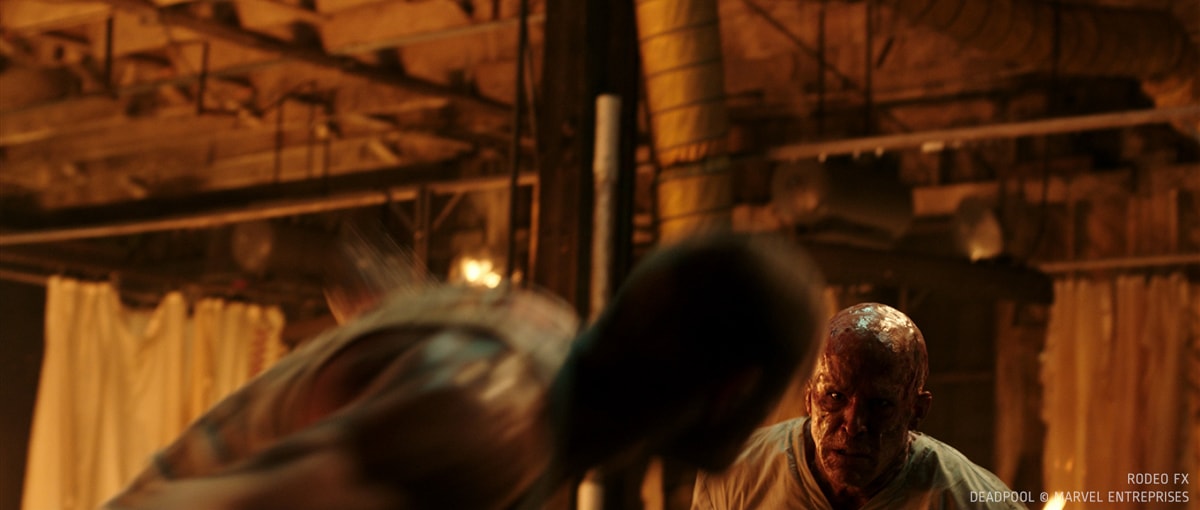
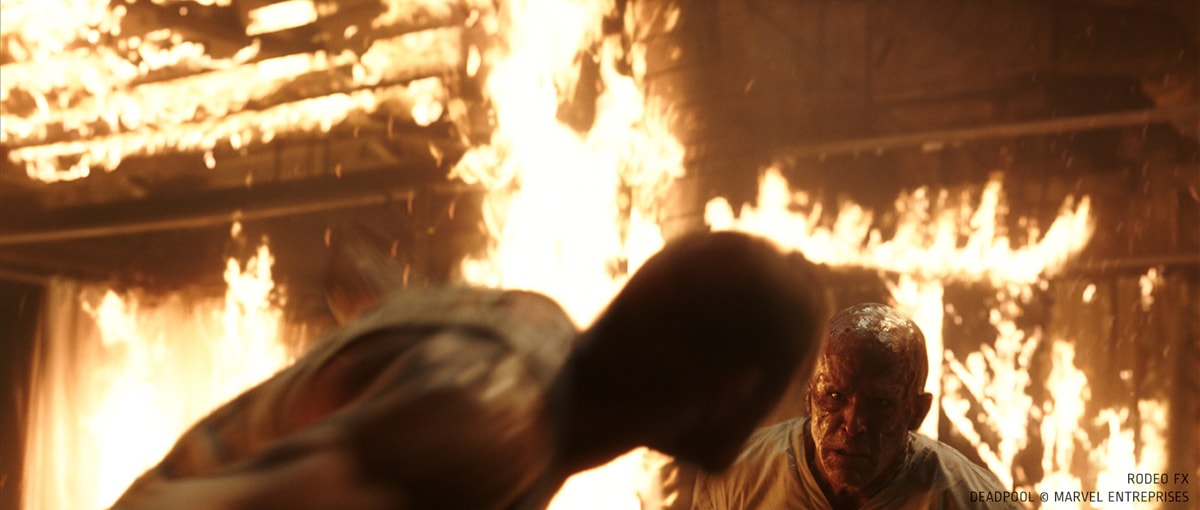
Rodeo also staged their own elements shoot where matching pieces of the burning set were built to full or half scale and then set on fire. “I had the edit with me,” says Brinton, “and we would look at a shot and think about where it would be cool to add some fire. Then we set something up to match it like a burning wall or pieces of debris dropped from a ladder.”
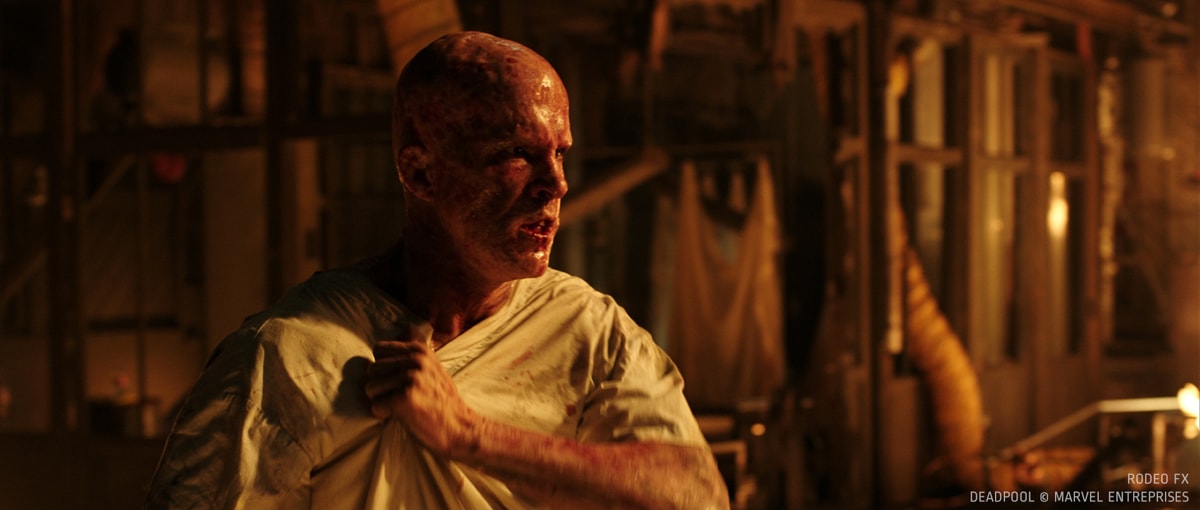
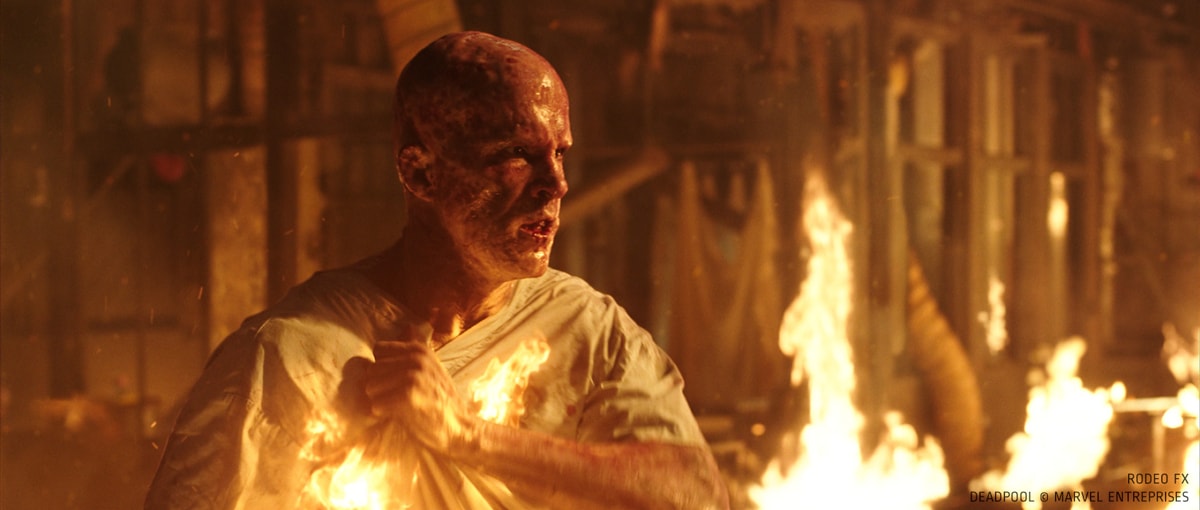
Other challenges in the burning warehouse included replacing much of the floor with CG areas and debris, since the floor used for shooting had incorporated stunt crash mattes. Another, more unexpected, challenge came when Rodeo was asked to give Wade a CG penis. “Ryan had been filmed in this scar make-up (by Bill Corso) from head to toe,” says Brinton, “and at one point he has to rip off his burning clothing, which we did as a cloth sim, but then once they’d done the edit they realized because he was effectively naked he had to have this CG penis. We had to make a concept, have it approved by the director and the executives and Ryan. Then we went into modeling, rigging, texturing and lighting, animating and comping. It was in six shots - it was never hero. It wasn’t meant to be comedic - it was one of those things that’s when it’s there it looks so natural that you don’t even notice it. When it wasn’t there it looked really weird.”

Well, it is R-rated…
Always intended as an R-rated film, Deadpool relied heavily on practical, make-up and digital visual effects for its blood and gore. One of the vendors responsible for significant gore effects was Luma Pictures, which Rothbart says impressed him with the limits they were willing to go to. “When we started this show, the deal is, this is Deadpool,” recalls Rothbart. “I would say, ‘You should take this as far as you can take it and just try to make me say please stop.’ They went for broke. They had this one shot they showed us as Deadpool cuts this guy’s stomach and literally his entire intestinal track goes flying out of his body along with massive amounts of blood. And I said, ‘OK guys, you got us!’. And they said, ‘Well you do have 50 feet of intestines’ but I got them to just make it a foot and a half.”Luma adopted several approaches to this kind of work, one of which was shooting real elements. “One of our artists went down to Home Depot and got all this PVC piping and bought all the corn syrup and a pump,” says Luma Pictures visual effects supervisor Vince Cirelli. “He pressurized all these PVC pipes with a cap and then created this little lip that he’d yank off and then all this gore and blood would spew out of these pipes. It just covered the room with stuff!”
Shot from multiple angles, the elements could then be worked into the plates via their Sprite-o-Mater tool which is usually used for generating sparks but was upgraded to handle blood spurts. “Anywhere we could get away with not using a simulation we actually used the old video game trick by using sprites that match the camera angle,” states Cirelli. “Sprite-o-Mater blends between the views based on camera angle for the artist. They can cycle through a library of these blood and gore elements that are shot with a camera setup.”
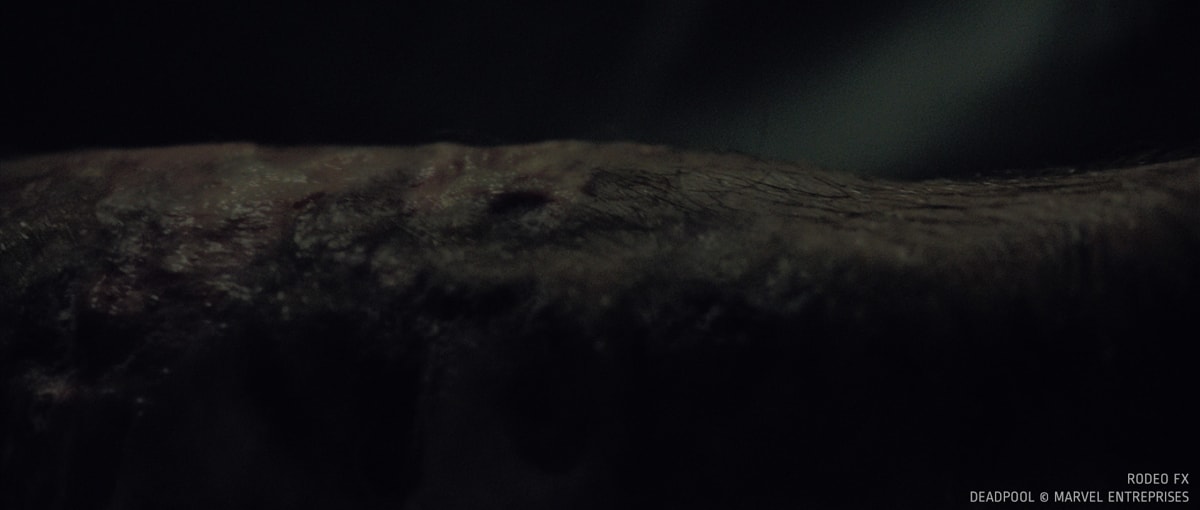
Later, shots of Deadpool’s hand growing back were achieved with a digital limb by Luma in another gross, but comical, scene. “It was tricky because it couldn’t be like a baby hand, because a baby hand actually doesn’t look like that,” notes Cirelli. “It needed to be a fetus hand. They were sending us this horrible reference of fetus’ but it was so we could get that translucency right. We used a multi-layered shader in Arnold for the sub-surface and we actually had geometry inside that geometry to really get the veining.”
Working together: the final battle
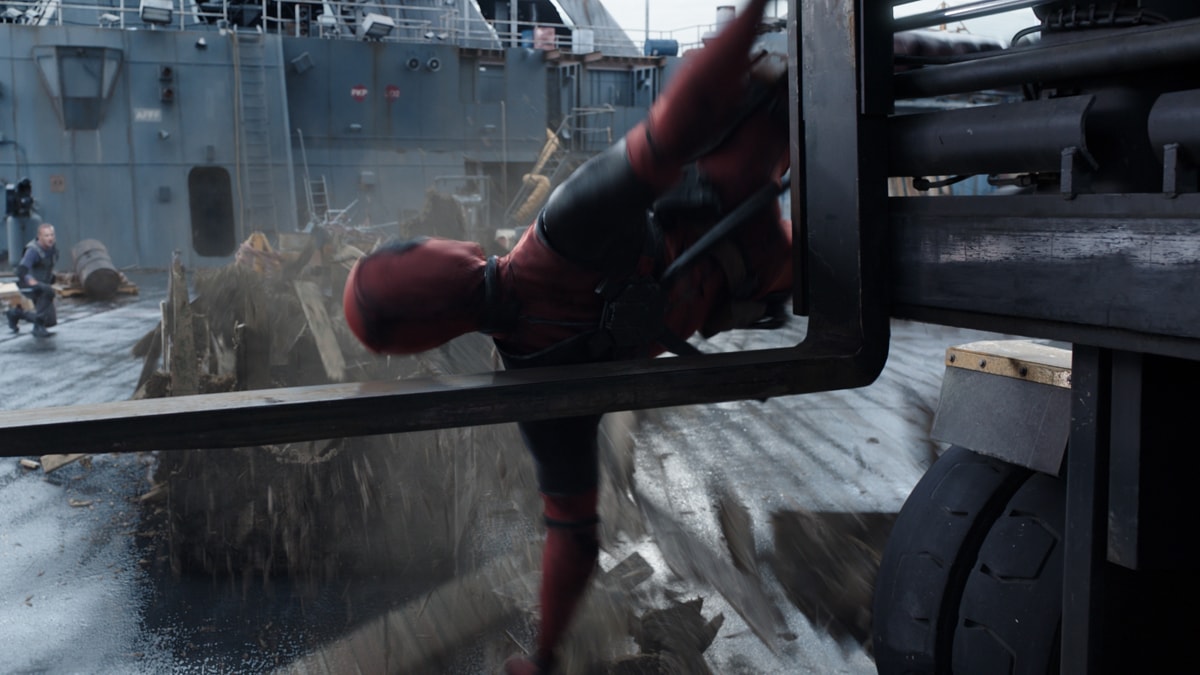
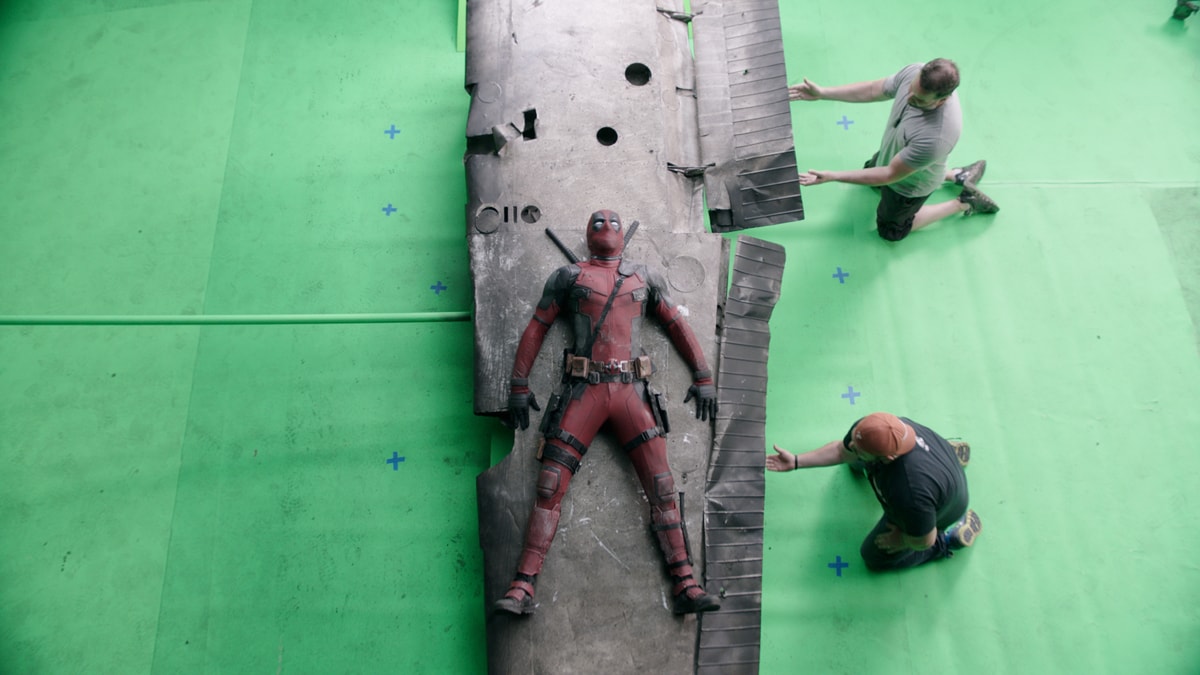
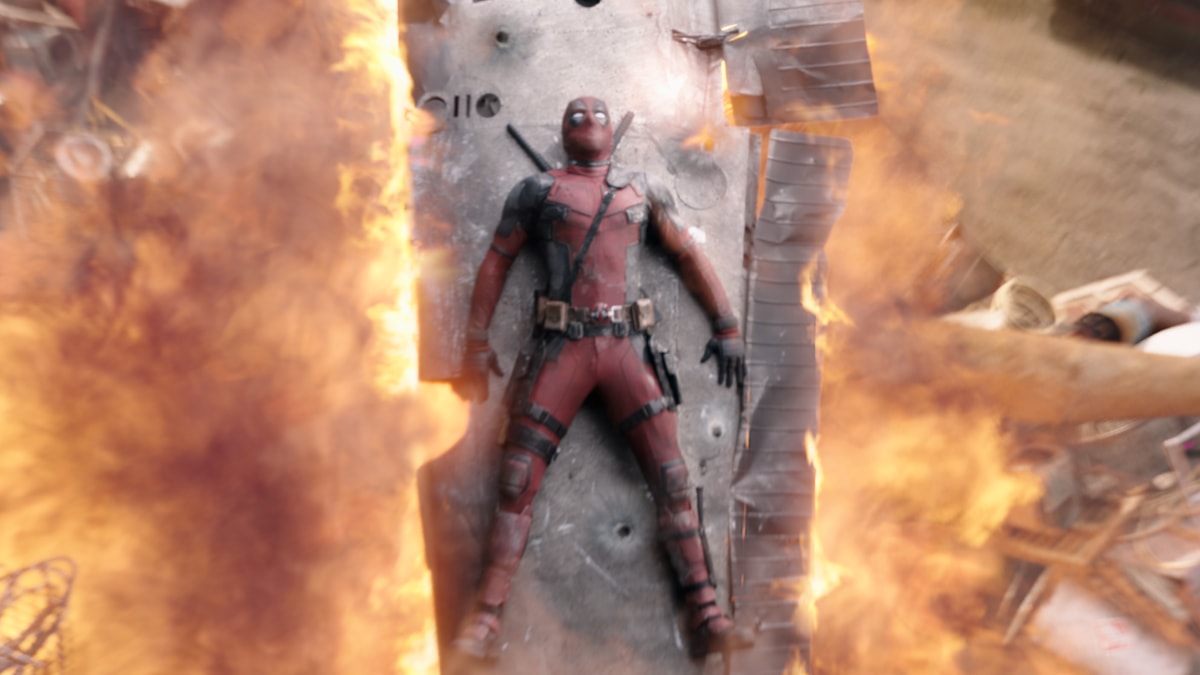
One spectacular scene from the showdown, realized by Digital Domain, sees NTW use her explosive powers to launch Deadpool on a piece of metal up to an area that Ajax has the superhero’s girlfriend hostage. “Tim described NTW to me as a fuel air bomb,” says Rothbart. “They’re these bombs where they launch them and explode but only ignite when the fuel spreads out. So you get this massive combustion moment but spread out into this huge large area. But we also needed something to show the genesis of the effect, so DD came up with something that looks like the solar flares of the sun.”
All images and clips copyright © 2016 20th Century Fox

 OK, I get the message: Deadpool is an Imax-sized parody based on a script that is at once self-mocking and delusional. But more important, it’s a giant R-rated hit that registered a
  —Deadpool features a terrific performance from
  Try asking the “suits” why Deadpool has connected with its audience you elicit the usual executive hyperbole. “You can’t underestimate the value of talent input,” declares Paul Hanneman, Fox’s head of global marketing and distribution. “The audience is responding to authenticity,” reflects Jim Gianopulos, who does not detail what elements were “authentic.”
 Indeed Fox pursued an array of contrarian strategies in fostering Deadpool. They budgeted a paltry $58 million, less than half the normal superhero outlay. They disdained 3D. They picked a first-time director, an animator named
  And they instructed their marketers (social and otherwise) to follow a similarly perverse course. The first images of Deadpool showed him splayed on a bearskin rug (a spoof of Burt Reynolds?). From the positioning of Deadpool’s handguns on billboards, viewers are led to believe the character is more phallic than fierce. Even the New York Times took exception to a poster using an emoji to depict excrement. Then there’s the moment when Deadpool kills his interviewer, host Mario Lopez, on air.
 It’s possible to intellectualize all this by declaring that the success of Deadpool embodies the end of the superhero era, when success can only be achieved through self-parody. In the last days of the Western genre, comedy supplanted gunfights and the heroes were played by Elvis, not John Wayne.